
Stop Silencing Us Mesa City Council: NO to NTT Mesa PH10!
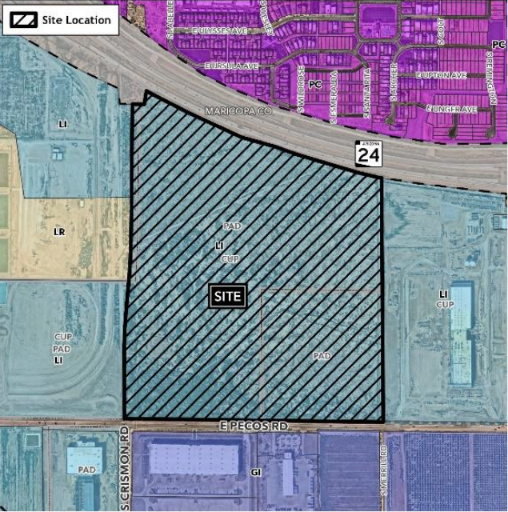
On May 13, 2026, the Mesa Planning & Zoning Board quickly and quietly voted unanimously to recommend approval of the 2,257,581 sq ft Mesa Data Center Campus known as the NTT Mesa PH10. Located near South Crismon and Pecos roads, the seven-building project represents a $300 million land acquisition and is slated to open its first phase in November 2028.
The owner of the project, NTT Global Data Centers PH10 LLC, is Nippon Telegraph and Telephone Corporation (NTT), a publicly-traded, multi-billion-dollar global technology and telecommunications giant headquartered in Tokyo, Japan.
NTT plans to build a massive, 2.25 million-square-foot data center campus consisting of seven buildings and two power substations (one private, one for SRP). To do this, they are asking the city to alter the property's current industrial zoning rules and modify the site's layout plans. NTT also wants to lock in a massive 7-building campus while bypassing the city's newly adopted, tougher regulations for data centers.
Background
The original plan failed: The city already approved a data center on this exact property back in August 2024 for a different developer. That project fell through.
New developer, new plan: This new developer is taking over the land but wants to change the previously approved layout to fit their own massive 7-building design.
To see the entire legislation → 1. Staff Report, 2. Narrative, 3. Site Plan, 4. Landscape Plans, 5. Grading and Drainage Plans, 6.Elevations, 7.Citizen Participation Plan, 8. Citizen Participation Report, 9. Presentation
Why New City Standards Don't Apply
Mesa recently passed a new law (Ordinance No. 5957) that forces data centers to meet much stricter design, environmental, and development standards. However, this developer does not have to follow those new rules because:
Pre-approved land use: The property was already legally designated for a data center under the old rules.
Beat the clock: The developer snuck their application in on August 4, 2025—just right before the city's new, stricter data center ordinance officially went into effect.
Mesa City Council Silencing Mesa Residents Voicing Opposition to the Data Center
Rather than addressing community concerns, Mayor Mark Freeman and the Mesa City Council are actively attempting to suppress public opposition. Our sister group, Indivisible Mesa — which has been fighting both this data center and the city’s 287(g) agreement for months — notes that city leadership is escalating attacks on our First Amendment rights through shifting rules and selective enforcement:
The Mesa City Council is actively trying to silence Mesa residents by:
Aggressive Removal: During the June 8th meeting, an attendee against NTT Mesa PH10 was peacefully holding a 8.5” X 11” sign that was not blocking anyone's view. A MAGA attendee created a scene by yelling at them to lower it, yet security physically removed our supporter while ignoring the MAGA disruptor. See video of cops aggressively removing attendee via our Instagram page or our Google Drive.
Digital Suppression: On June 11th, Mesa Valley Indivisible posted unedited video footage of that peaceful attendee being forcibly removed by Mesa police under Mayor Mark Freeman's orders. Shortly after tagging the Mayor and Mesa City Council, our organization's Instagram account was reported and taken down. MVI routinely publishes unflinching advocacy content without issue, making this unprecedented, rapid removal highly suspicious. We view this as a coordinated effort by the Mesa City Council and the Mayor to again suppress opposition and silence the residents of Mesa.
Attempted Suppression of Public Turnout: On July 14th, three days prior to the next scheduled meeting on July 17th, the Public Information & Communications Specialist emailed advocacy groups stating the NTT project was not on the agenda—a blatant tactic to discourage public attendance after the last meeting. We already knew the project was not on the agenda just like it was not for the June 8th meeting, but we wanted to ensure the Mesa City Council (MCC) knew from day one that we fiercely oppose the NTT Mesa PH10 project.
Banned Signs: On July 16th, MCC updated the rules yet again to attend Mesa City Council meetings. “Signs, flags, banners, posters, placards and other held or carried display materials are not permitted inside City Hall or during public meetings”. View their Facebook post here.
Arresting Protestors: When indoor bans forced MVI to demonstrate outside, police escalated suppression on the steps of City Hall by arresting a protester for using a megaphone—even though she immediately complied when asked to stop. She spent the night in jail on bogus charges that were rightly dropped in late September. See the video of the arrest on Instagram or our Google Drive.
Bypassing the Public Vote: When Indivisible Mesa recently pressed the City Council coordinator for answers on August 7, 2026, the city shifted its story again—now claiming that councilmembers will not be voting on the data center at all and that NTT can proceed administratively.
Why wasn't this disclosed earlier? Because city leadership saw a surge of community members showing up to protest and they are desperate to dodge public accountability. They had multiple opportunities to clarify the approval process, but only claimed no vote was needed after grassroots pressure began mounting.
These constant, shifting rules are designed to make us invisible. But we we refuse to back down. If they won't let us show our signs inside, we will make sure they are impossible to ignore on the steps of City Hall. We will make our voices heard loud and clear outside! Click here to register for our October 26, 2026 protest!
What YOU Can Do to Stop NTT Mesa PH10
Join Mesa Valley Indivisible to protest the data center and the Mesa City Council for silencing its constituents → October 26, 2026
Read Mary-Beth Meagher’s article on the NTT Mesa PH10 Data Center on Our Blog page
Tell council members by submitting comments, emailing, and signing the petition that you do not want this massive data center. Please see below for links, templates, and more.
Whether or not you can attend, please do the following three things:
1. Submit a comment here! Feel free to choose one of the concerns listed here if you do not want to write your own comment.
2. Email the Mesa City Council members! Contact info, directions, and scripts/templates provided!
3. Sign the petition to tell the Mesa City Council that Mesa residents do not want this 2.2+ million square foot data center!
Our Key Concerns
Negative Financial Impact
Massive Handouts: Similarly sized data centers receive over $100 million a year in tax subsidies. That is revenue stolen directly from our local community services and neighborhood improvements.
Virtually No Job Creation: Despite taking up huge amounts of space, this massive facility will only create 40 to 60 permanent jobs paying $60,000 or less. Compared to advanced manufacturing or bioscience, data centers provide practically zero high-quality jobs per acre.
We Pay Their Bills: The infrastructure improvements and utility upgrades required for this project will likely be passed on to everyday customers, not the multibillion-dollar company.
Driving Up Local Costs: Developments like this artificially inflate land costs, making it harder for our local farmers, small businesses, and families looking for affordable housing to survive.
Wildlife & Ecological Harm
Developing a massive 2.25 million-square-foot footprint destroys vital desert habitat and fragments local wildlife corridors. Furthermore, 24/7 low-frequency fan noise and light pollution severely disrupt local wildlife species, desert birds, and nocturnal pollinators that rely on acoustic and natural cues to hunt and mate.
Draining Our Desert
A 2.2 million-square-foot facility requires an astronomical amount of energy and water to keep its servers cool. In our delicate desert environment, this level of resource consumption is completely unsustainable and directly threatens the capacity of our local utilities.
Ruining Our Neighborhoods
This project threatens the safety and peace of our residential areas. The constant, 24/7 roar of massive cooling fans creates severe noise pollution, while the sprawling, windowless buildings will industrialize our local landscape and destroy our community's character.
Failures of Closed-Loop Cooling Systems in Data Centers
Yes — closed-loop cooling systems in data centers have experienced significant failures, sometimes with cascading impacts on uptime and equipment.
High-profile example: In July 2022, during a record heatwave in London, multiple redundant cooling systems at one Google data center failed simultaneously. This included both chilled water and computer room air handler (CRAH) systems, disrupting services for customers across the europe-west2-a zone. Google’s incident report confirmed that the failure of multiple redundant systems caused service unavailability for impacted products Fluke Corporation.
Why closed-loop systems are vulnerable:
Gradual degradation: Failures often start with small mechanical issues — such as fouling in pumps, misalignment, bearing wear, or cavitation — which reduce efficiency before alarms trigger Fluke Corporation.
Thermal inertia: In a closed-loop chilled water system, heat exchangers and water retain thermal energy. When pumps or fans fail, temperature changes are delayed, but the system can still overheat if the fault is not detected quickly Semiconductor Engineering.
Chemical and biological fouling: Scale, mineral deposits, and microbial growth in cooling circuits reduce heat transfer efficiency, increase pressure drop, and can cause corrosion — all of which degrade closed-loop performance over time eaiwater.com+1.
Direct liquid cooling (DLC) risks: In DLC systems, a leak or pump failure can cause chip temperatures to rise rapidly, potentially leading to shutdown in under a minute ASME Digital Collection.
Impact of failures:
Cooling-related problems were the second leading cause of unplanned data center outages in 2023, responsible for nearly one in five incidents worldwide Fluke Corporation.
Even in hyperscale facilities with redundancy, simultaneous cooling system failures can overwhelm backup measures, especially during extreme ambient temperatures Fluke Corporation.
Prevention and mitigation:
Regular cooling circuit testing and chemistry control to prevent fouling and corrosion Alliance Chemical.
Vibration and performance monitoring to detect early mechanical faults Fluke Corporation.
Time-dependent simulation (e.g., CFD) to model failure scenarios and test resilience Semiconductor Engineering.
Redundant but independent cooling loops to avoid single-point failure.
In short, while closed-loop cooling systems are designed for resilience, real-world failures — from mechanical wear to chemical fouling — have caused major outages, underscoring the need for proactive monitoring, maintenance, and redundancy planning.